Sessions vs JWT vs Cookies: Understanding Authentication Approaches
Authentication is one of the most important parts of modern web development. Every app—whether it’s a simple blog or a large SaaS product—needs a way to identify users and keep them logged in.
To do that, developers mainly use sessions, cookies, or JWT (JSON Web Tokens). But many beginners get confused about how they work and when to use each.
Let’s break everything down in simple terms.
What are Sessions?
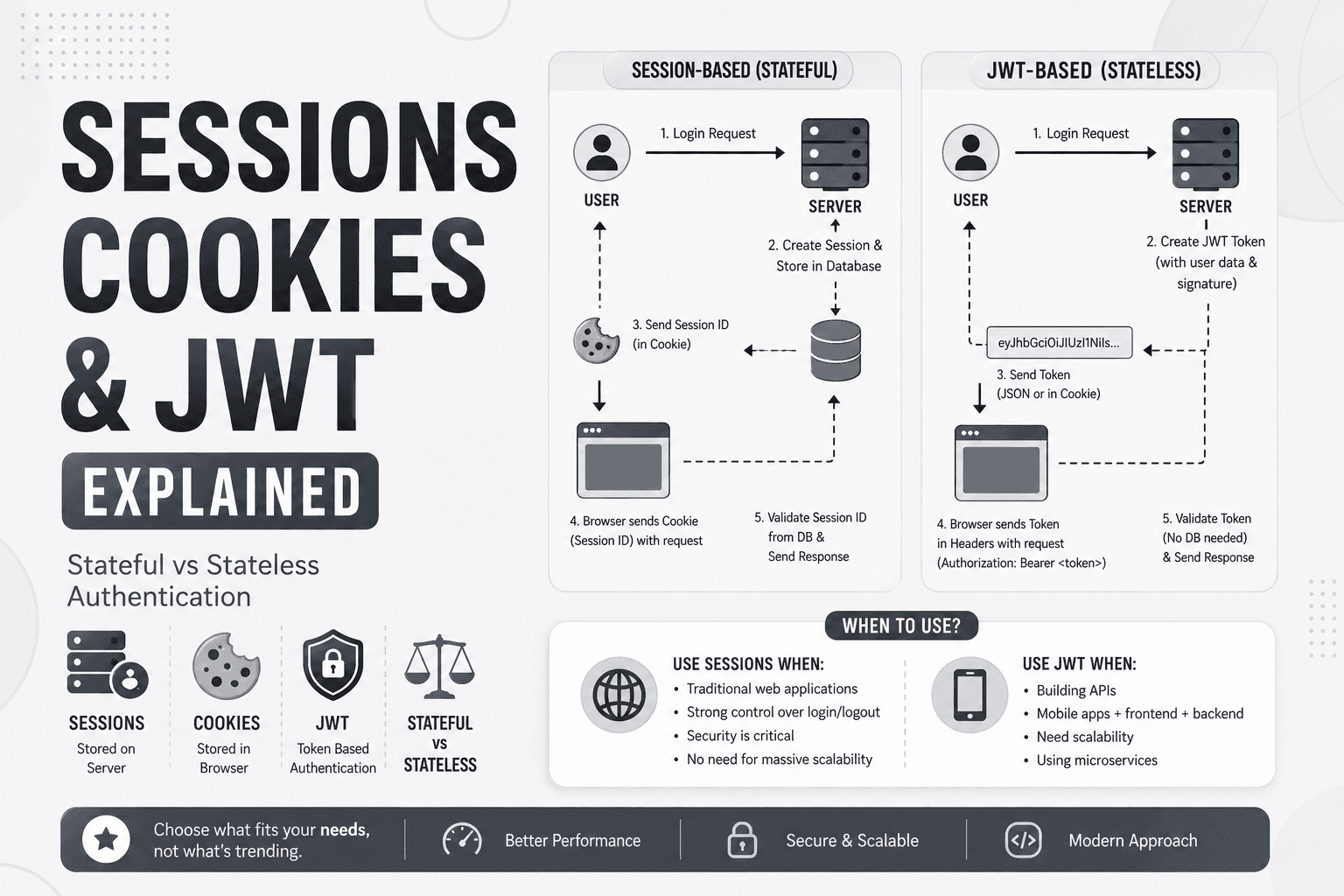
In session, instead of storing login details on the client side, we store them on the server side, meaning in the database.
What we actually do in this approach is that when a user creates a login request, the server creates a session and stores that session with the session ID and user data in the database, and sends back the session ID to the user side, or we can say, client.
After whenever client wants to access some resource, the browser sends the session ID with the request, and the server validates the session ID by fetching it from the database with the user and responds back.
In short: Session = user data stored on server + session ID in browser
What are Cookies?
A cookie is a small piece of data stored in the browser.
Cookies are mainly used to:
Store session IDs
Track users
Save preferences
When using sessions:
The session ID is stored in a cookie
The browser automatically sends it with every request
What is JWT (JSON Web Token)?
JWT is a completely different approach.
In this approach of authentication, when a user creates a login request to the server, the server creates a token with user data embedded on it with a unique signature and send back to the client-side browser cookie or responds back as JSON, the client saves that in localStorage.
From the next time when the client needs a resource, it sends the token server and validates it without invoking db cause we already have the user data in the token and sends the requred respond.
Stateful vs Stateless Authentication
Now things get very interesting. This is the key difference between Session and a JWT-based authentication system.
Stateful Authentication
The server stores the user state
Each user has a session stored on the server
The server must remember every user
Session-based authentication is stateful.
Pros-
The server has more control over the user; if the server wants, it can log the user.
Less exposure of user data.
Cons-
Require a DB operation for each request, which makes the operation a little bit slower if the DB is busy.
Not ideal for scaling.
Stateless Authentication
In this authentication, the server sends a token, and the user sends back the token to the server for each request. server no neeed to store those tokens. Basically, the server does not maintain any state, so it is stateless.
JSON Web Token is Stateless Authentication
All user info is inside the token
The server just verifies the token
Pros-
Easy to manage logout
More secure control from the server
Less exposure of user data
Cons-
Requires server memory
Not ideal for scaling
Needs session store (Redis, DB)
Session-Based Auth vs JWT
Here’s a clear comparison:
| Feature | Session-Based Auth | JWT Auth |
|---|---|---|
| Storage | Server-side | Client-side |
| State | Stateful | Stateless |
| Scalability | Harder (needs shared storage) | Easy |
| Performance | Slower (DB/session lookup) | Faster |
| Security | More control | Depends on implementation |
| Logout | Easy | Hard (token remains valid) |
| Data Storage | Minimal (ID only) | Can store extra data |
| Use Case | Web apps | APIs, mobile apps |
When to Use Sessions
Use session-based authentication when:
You are building a traditional web app
You need strong control over login/logout
Security is critical (banking, admin panels)
You don’t need massive scalability
Example:
Admin dashboards
Internal tools
Server-rendered apps
When to Use JWT
Use JWT when:
You are building APIs
You have mobile apps + frontend + backend
You need scalability
You are using microservices
Example:
REST APIs
React / Next.js frontend with backend API
Mobile apps
Note that most biggineer had confusion about whether to use between stateless and stateful. Instead, they should focus on what actually fits their needs.
Key Takeaways
Sessions store data on the server
Cookies store small amounts of data in the browser
JWT stores data inside the token itself
Sessions = stateful
JWT = stateless
Choose based on project needs, not trends